Without the need for sleep, the writer Jenny Diski once wrote, we could abolish “the second most absurd thing we do: wake up.” America may have just been her dreamland.
Roughly 1 in 3 American adults get less than 7 hours of sleep. And if you happen to be a sound sleeper, chances are your neighbors are not. Fully 99.4% of adults live in a census tract where at least a quarter of residents are short sleepers.
Our new map of sleep data is available online for free.
1. National Snapshot
In a typical American neighborhood, more than a third of adults aren’t sleeping enough. More, a little over 15% of census tracts exceed 42% short sleep. That’s roughly 1 in 8 Americans living in a neighborhood where a little over two-fifths of the residents are sleep-deprived.
At the extreme end, 2.6 million adults live in tracts where more than 50% of residents are sleeping less than seven hours.
Even the country’s most well-rested neighborhoods aren’t faring that well. The single best tract in America, in Fairfax County, VA, still has around 20% of residents sleeping short. To put that differently, there is no neighborhood in America where more than 80% of residents are sleeping more than 7 hours.
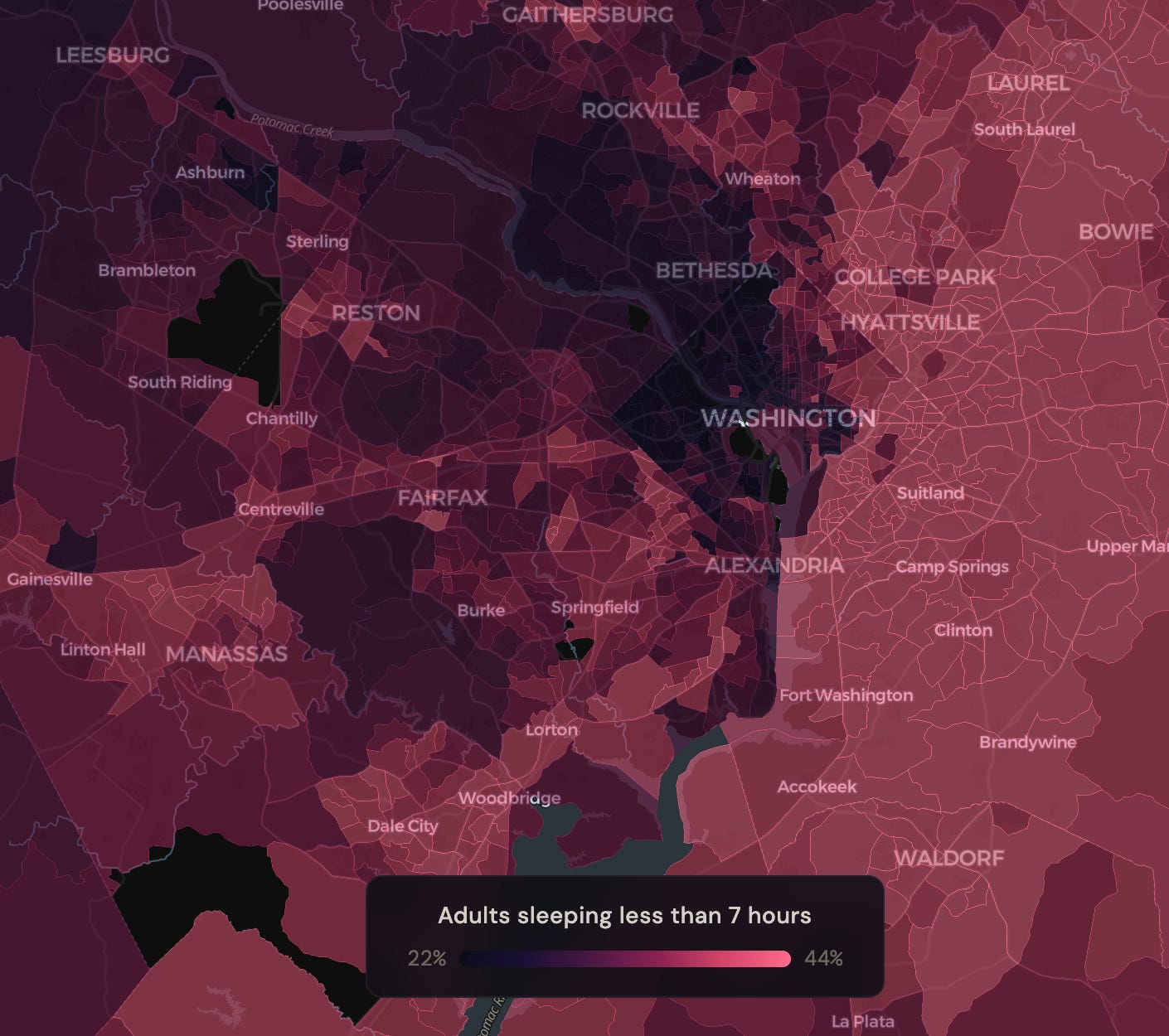
The point about Fairfax reveals something of note. 80% of American neighborhoods fall within a 14 percentage point difference of each other when it comes to poor sleep. What that means is the spread between well-rested neighborhoods and the sleep-deprived neighborhoods is not overly prominent. In America, the universal baseline is a lack of sleep with pockets of crisis on top.
2. Best and Worst States
Hawaii, Indiana, Georgia, and Florida are all home to some of the poorest sleeping tracts.
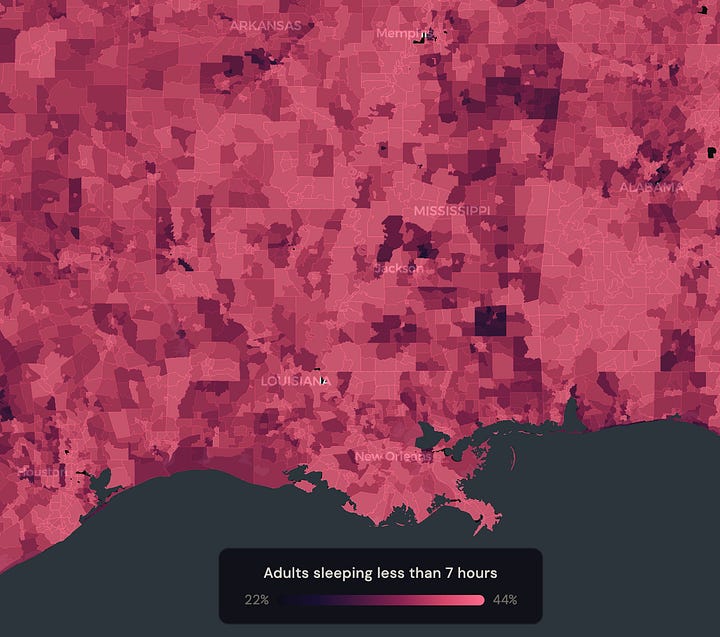
However, accounting for population, the worst-slept states are Hawaii, West Virginia, Nevada, Louisiana, and Kentucky, respectively. Nearly 78% of Hawaii’s tracts, and 32% of Nevada’s exceed 42% of adults with poor sleep.
Over 41% of West Virginia’s tracts and 35% of Louisiana’s exceed that same 42% threshold
This isn’t surprising for some given the high cost of living and tourism-reliant economies that characterize the economic landscape in Hawaii and Nevada. While places like West Virginia, Louisiana, and Kentucky, contain outsized rural poverty, extractive economies, labour markets organized on shift work, and chronic disease burden.
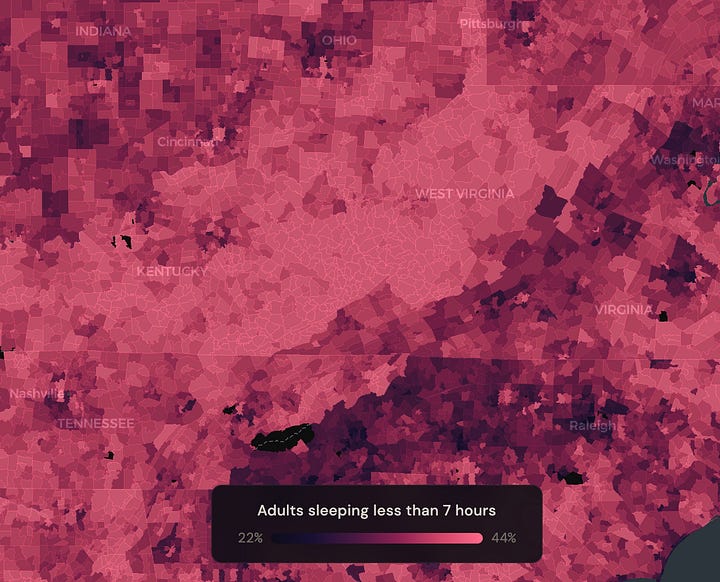
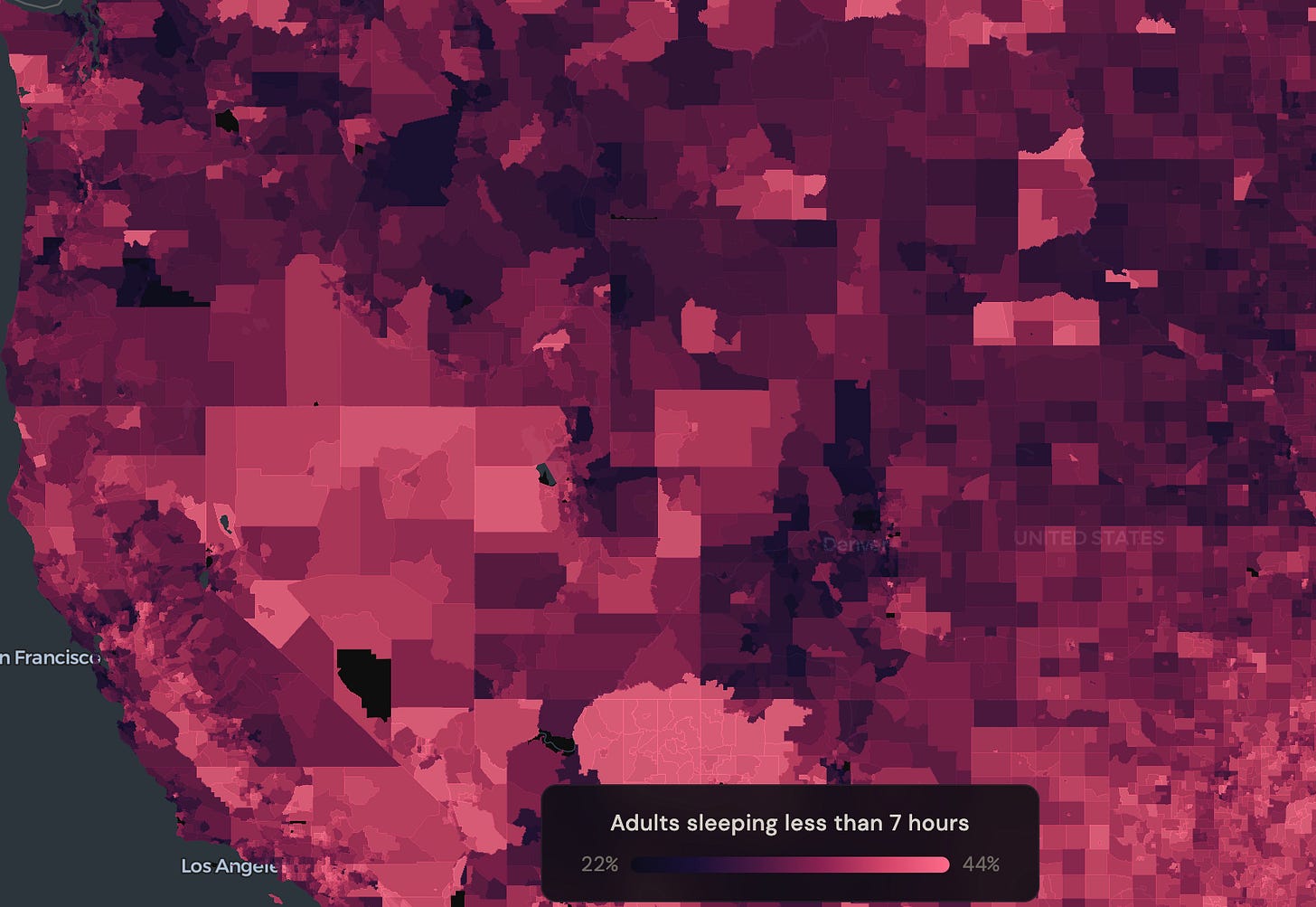
The most well-rested states are Vermont (29.0%), Minnesota (29.6%), South Dakota (30.2%), Colorado (30.9%), and Oregon (31.1%).
These states also share remarkably compressed distributions within their own borders. Vermont and Minnesota have virtually zero tracts where 42% of residents are sleep-deprived (0.00% and 0.27% respectively). And, their standard deviations hover around 3.3 to 3.6 points. In other words, no matter where you go in Vermont or Minnesota, sleep patterns will be similar, regardless of which neighborhood you're in.
If we compare this to a state like Louisiana, where around 40% of the population is running on short sleep, the standard deviation there is 5.37. That means tracts are scattered more widely. In some, 35% of residents are chronically sleep-deprived while other tracts push closer to 48%.
Patterns of sleep between states and within states vary widely.
3. Gaps
State averages can offer some insight, but they hide a more troublesome story. Namely, how different your sleep outcomes are depending on which neighborhood you live in. One way to measure that is using the gap between a state’s 90th percentile tract and its 10th percentile tract (a P90–P10 gap). A larger gap signals sharp neighborhood-level divides, a small gap means the state’s experience is more uniform.
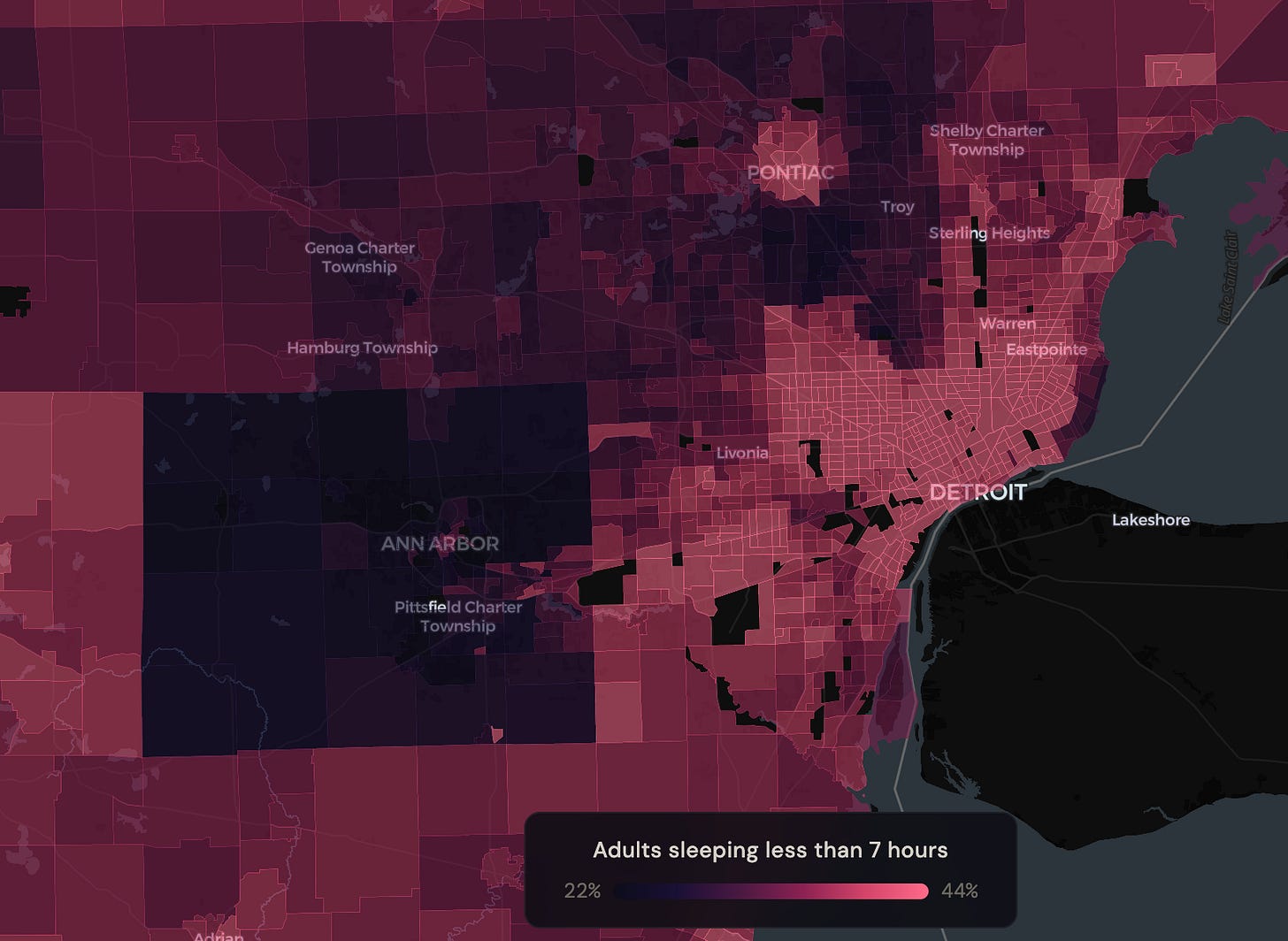
Michigan and Washington D.C have the sharpest neighborhood divides in the country. Each state (if we consider D.C. a state) has a gap of nearly 19 points. In Michigan, one tract might have 29% of adults short on sleep while another has 47%, all within the same state. The visual difference between Ann Arbor and Detroit makes this divide stark.
In DC, the difference between the affluent upper Northwest and neighborhoods east of the Anacostia is stark. In the best-sleeping 10% of DC neighborhoods, roughly 1 in 4 adults are short sleepers. In the worst 10%, it’s closer to 1 in 2.3.
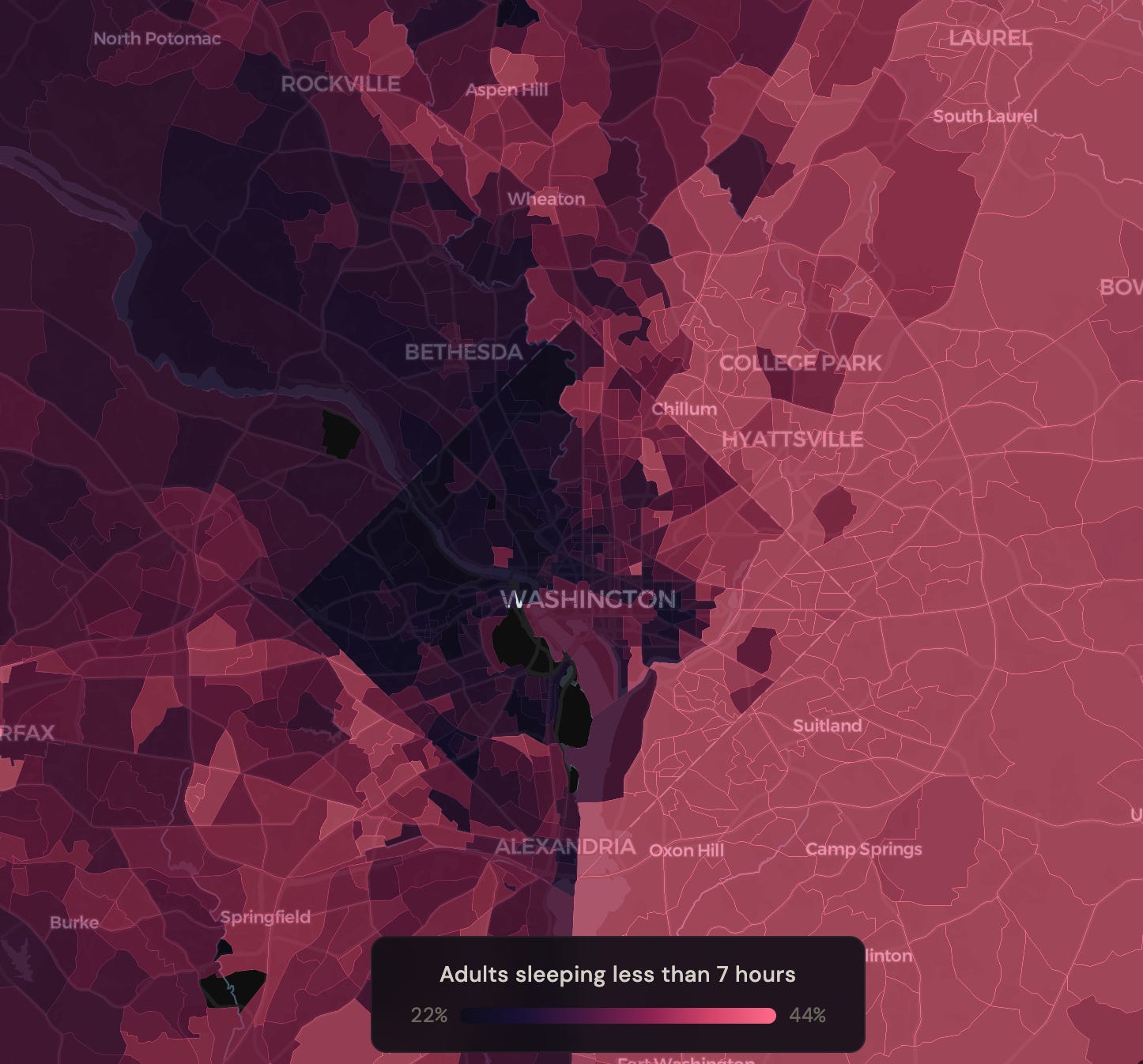
In the best-sleeping 10% of DC neighborhoods, roughly 1 in 4 adults are short sleepers. In the worst 10%, it’s closer to 1 in 2.3.
Meanwhile, states like Minnesota and Wyoming have gaps under 9 points. The sleep problem there is not only lower, but the variation among neighborhoods is smaller too. In other words, sleep is more evenly distributed.
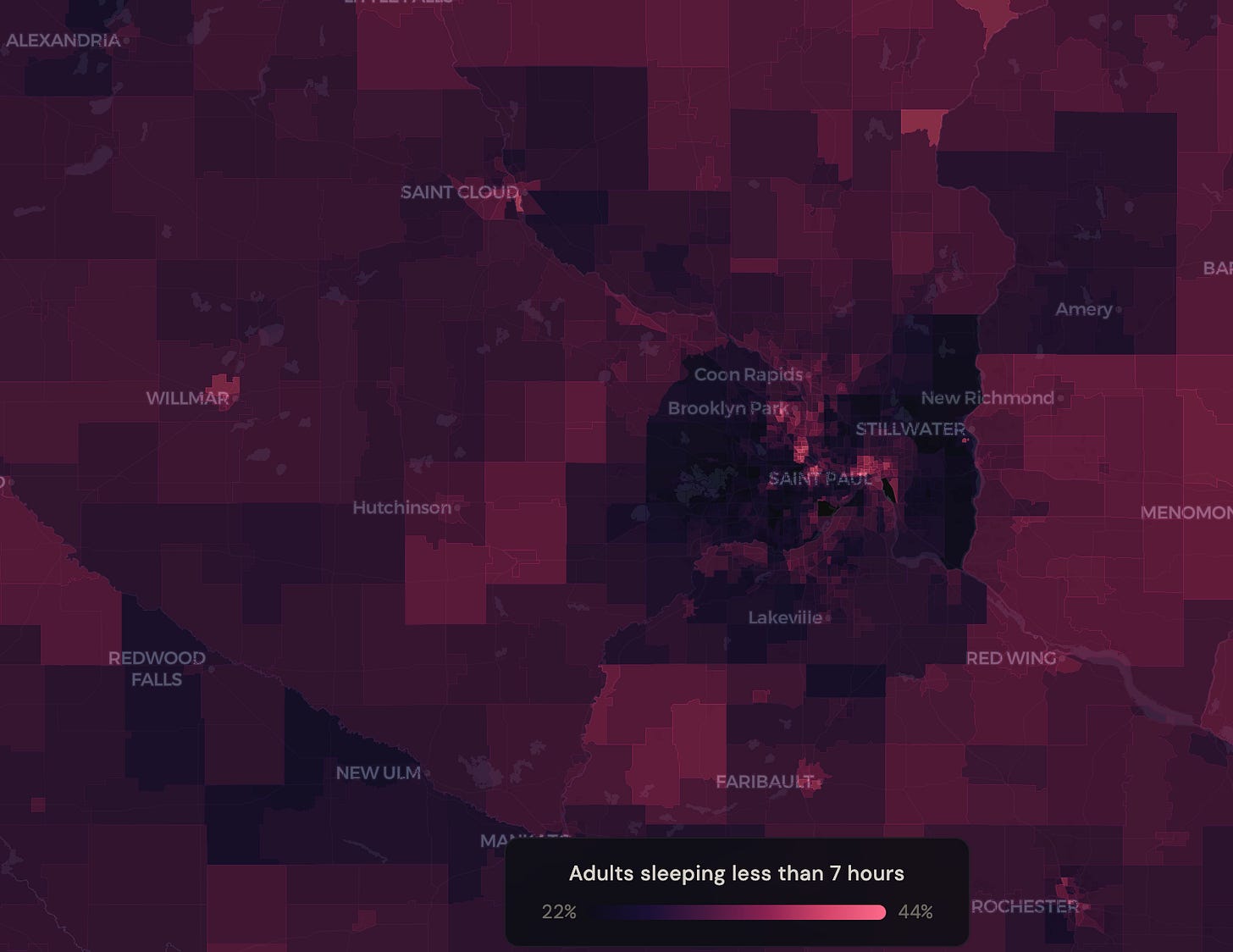
The takeaway is that a state’s average can mask the real story. Two states with the same number can look completely different on the ground— one with a moderate, shared problem, the other with pockets of deep deprivation sitting alongside neighborhoods that are, comparatively, doing just fine.
4. Tidewater, Virginia.
Hampton Roads is significantly more sleep-deprived than the nation. Adjusting for population, about 39.0% of the region is sleeping less than 7 hours, that’s around 2.5 points above the national mean. Translated, somewhere in the neighborhood of 530,000 adults are not getting enough sleep.
Nearly 1 in 3 Hampton Roads tracts are in severe territory. 30.0% of tracts exceed 42% short sleep, about double the national rate of 15.3%.
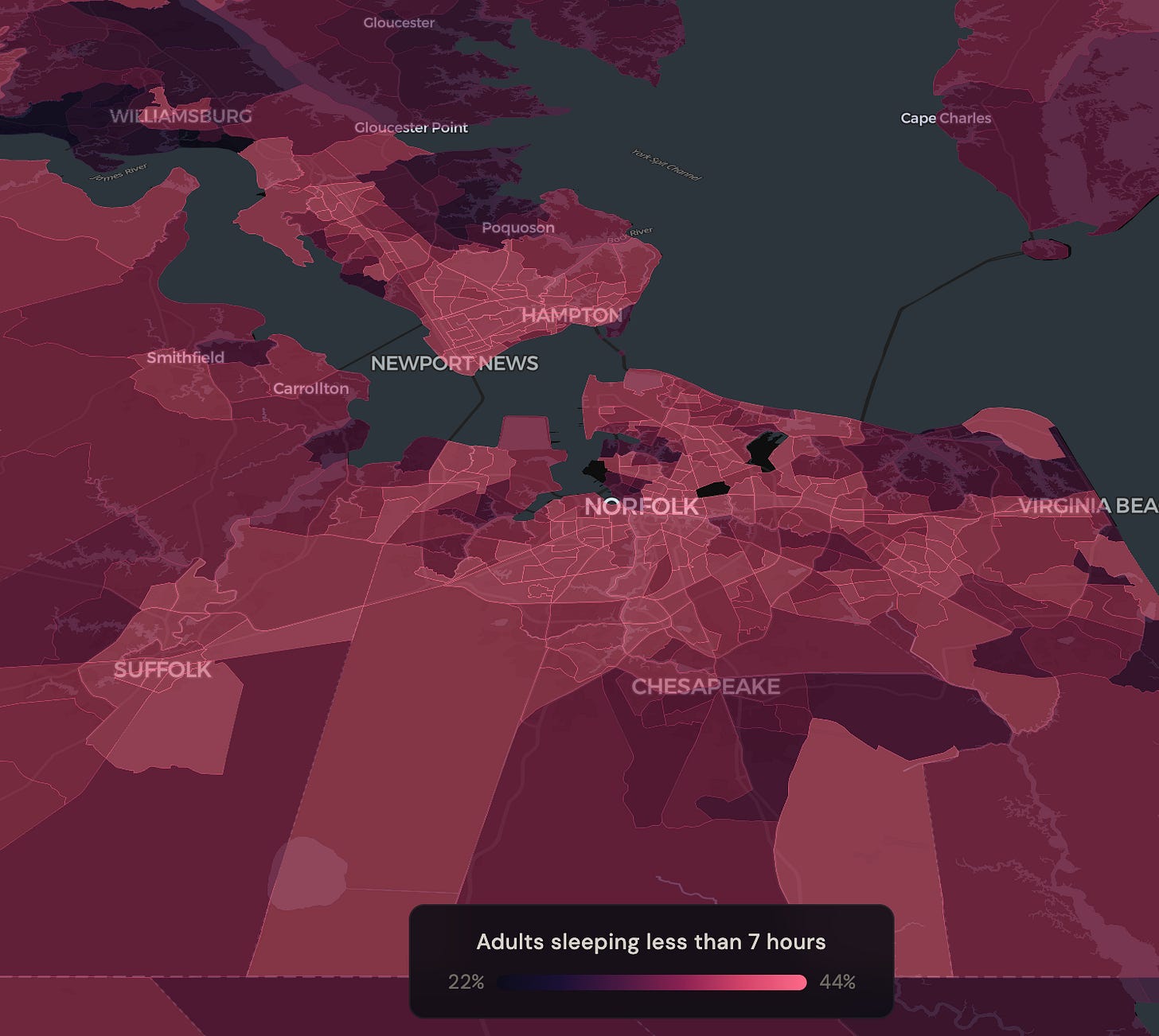
Hampton and Portsmouth have the largest population of sleep-deprived residents, relative to the region, 44% and 43% of residents there get less than 7 hours sleep. Virginia Beach is the exception in the region for good sleep. At 38.2% it’s the only locality that approaches the national average (and even it’s above it).
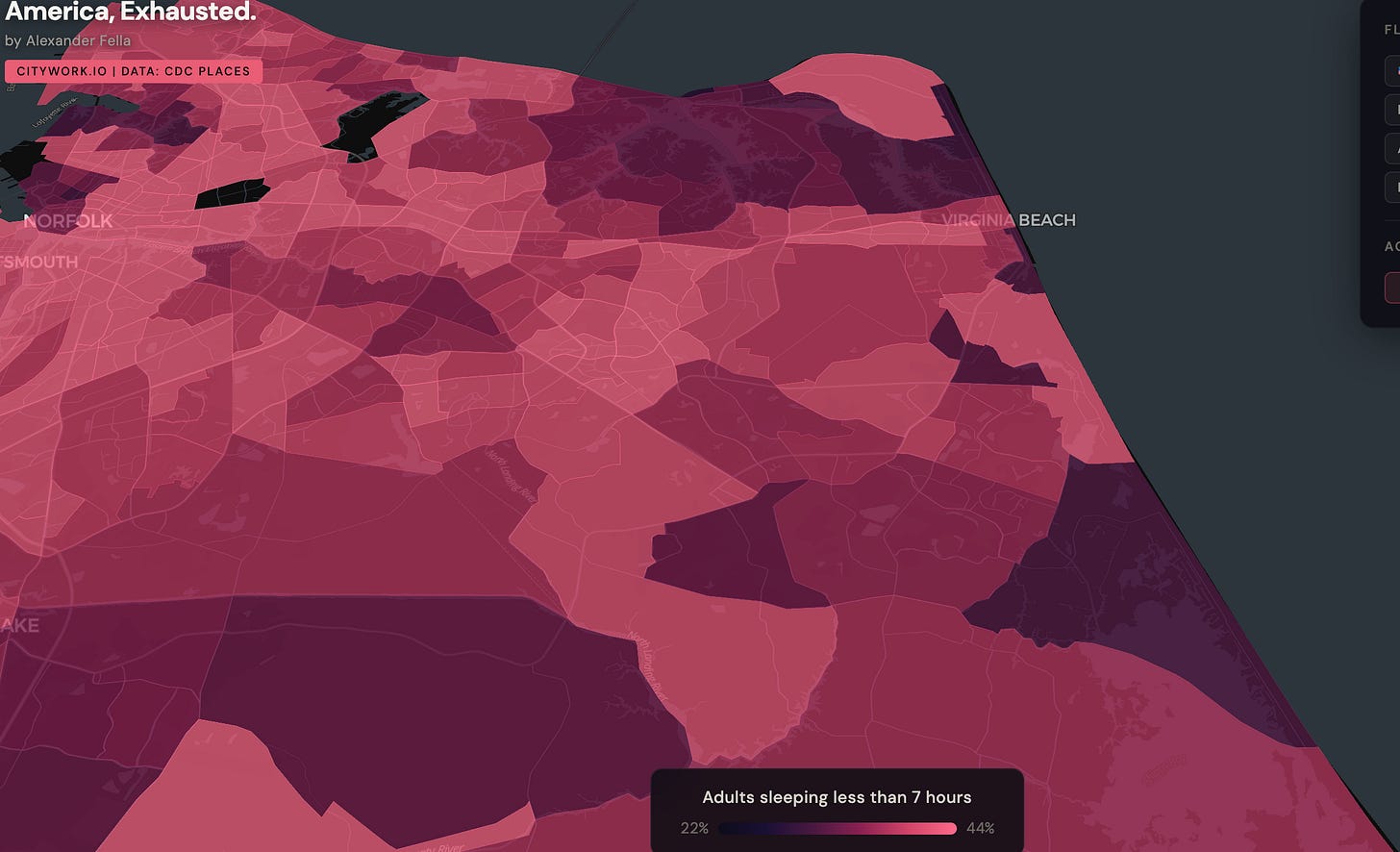
While Hampton and Portsmouth have the largest share of sleep-deprived residents, the two worst-sleeping tracts in all of Hampton Roads are in Norfolk: 54.9% in Young Terrace and 54.7% in Tidewater Gardens. Both neighborhoods are majority-Black neighborhoods and among the poorest neighborhoods in the region. Those numbers approach the worst in the entire country (the national max is 61.5%).
Indeed, Norfolk’s internal inequality is revealing. Using the same P90–P10 above, Norfolk’s gap is nearly 15 points across just 77 tracts in a single city. For context, that’s wider than the neighborhood divide in Connecticut, Florida, New Jersey, or New York. At the extremes, the distance between Norfolk's best-sleeping neighborhoods and Young Terrace stretches to over 20 points.
Such a divide points to the impacts poverty, precarious housing, community safety, and reliable access to transportation have on sleep.
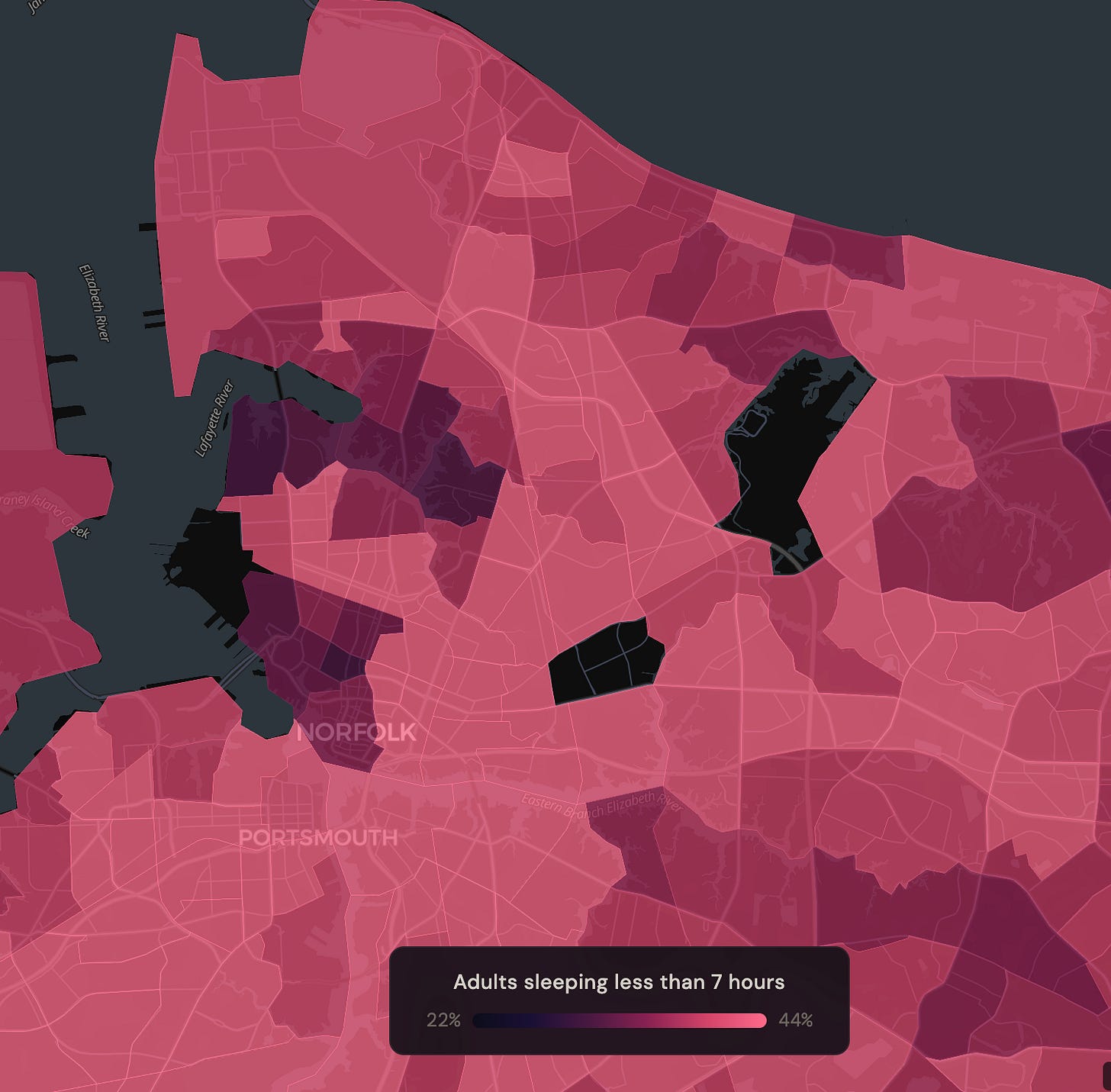
At the extremes, the distance between Norfolk’s best-sleeping neighborhoods and its worst stretches over 20 points.